I have to take my hat off to the US Bureau of Alcohol, Tobacco and Firearms (as the old joke goes, it sounds like one heck of a fun corner shop) for its efforts to push IP law in bold new directions by seizing the registered trade mark of a biker gang.
“In addition to pursuing the criminal charges set forth in the indictment, for the first time ever, we are seeking to forfeit the intellectual property of a gang,” said United States Attorney Thomas P. O’Brien. “The name ‘Mongols,’ which is part of the gang’s ‘patch’ that members wear on their motorcycle jackets, was trademarked by the gang. ... If the court grants our request for this order, then if any law enforcement officer sees a Mongol wearing his patch, he will be authorized to stop that gang member and literally take the jacket right off his back.”
Of course, US trade mark law is rather different from that in Europe. I can already see the spectre of Arsenal v Reed rising like, er, a rather naff example of biker jacket art, waving the banner of 'badges of affiliation'. After all, exactly what 'service' is a biker gang's logo being used in connection with? And is it in the course of trade?
Wednesday, 22 October 2008

Monday, 29 September 2008
But Service in Person is still far more satisfying
The latest amendment to the Civil Procedure Rules comes into effect on Wednesday, and amongst other changes the legal system has acknowledged the White Heat of Technology and recognised that SMTP packets travel slightly faster than First Class mail. Current CPR 6.7(1), which says that for electronic methods other than fax, service of a claim is deemed to have taken place on 'The second day after the day on which it is transmitted' is to be replaced EDIT: for a document other than a claim form by new CPR 6.26, which defines service as taking place:
'If the e-mail or other electronic transmission is sent on a business day before 4.30p.m., on that day; or in any other case, on the next business day after the day on which it was sent..'
UPDATE On a more careful read-through I see that the CPR amendment splits out service of Claim Forms from service of other documents. The above rule applies to documents other than claim forms; the revised rules for claim forms themselves actually slow down service, by applying the 'second business day' rule to all forms of service!
- in other words, the same as the rule for fax transmissions. Actually, on careful inspection I see that the fax rule has itself been updated to say that service happens on the same day if fax transmission is completed by 4.30p.m. So, if your accompanying Particulars of Claim are 43 pages long, don't send the trainee to the fax at 4.28...
UPDATE On a more careful read-through I see that the CPR amendment splits out service of Claim Forms from service of other documents. The above rule applies to documents other than claim forms; the revised rules for claim forms themselves actually slow down service, by applying the 'second business day' rule to all forms of service!
Wednesday, 17 September 2008
Why Not To Buy www.lloydstsbbarclaysrbsabbey.com
This BBC report notes how the sudden round of shotgun marriages in the banking and investment world has led some crafty individuals to register domains such as lloydstsbhbos.com and barclayslehman.com, presumably in the expectation that the post-merger banks - assuming that they are called that - will then have no choice but to pay whatever is asked in order to have a suitable domain name.
Funnily enough, this has been tried before. Many, many times; indeed, this particular scam predates the spread of the Internet. In Glaxo plc v Glaxowellcome Ltd [1996] FSR 388, a couple of company registration agents noted the announced merger of Glaxo and Wellcome and registered 'Glaxowellcome Ltd' as a company name, which they then offered to sell to Glaxo. Glaxo were unamused and sued successfully for passing off. As Lightman J put it:
"The court will not countenance any such pre-emptive strike of registering companies with names where others have the goodwill in those names, and the registering party then demanding a price for changing the names. It is an abuse of the system of registration of companies' names. The right to choose the name with which a company is registered is not given for that purpose."
The concept that such an abusive registration was an 'instrument of fraud' was seized on with enthusiasm by courts when looking at domain name hijacking, as in the leading case of British Telecom v One In A Million [1998] 4 All ER 476. Moreover, as resolution of domain name disputes has shifted from courts to ICANN-mandated resolution panels, such tribunals have readily adopted the doctrine that such pre-emptive registrations are abusive, as in America Online v Chris Hoffman, where the announced merger of Time Warner and AOL led the defendant to register timeforaol.com and other such domains.
Indeed, since the terms of service of domain name registrars invariably include a condition that any dispute is resolved under the ICANN Uniform Domain Name Dispute Resolution Policy, anyone trying this trick is unlikely to even have the chance to argue in court. Instead, they'll have to go to an ICANN-approved tribunal that is, on the evidence of AOL and similar decisions, likely to take such registration as prima facie abusive.
So, I wouldn't bid on www.barclayslehman.com if I were you. It's likely to be an even worse investment than Lehman stock turned out to be...
EDIT: I commented on this on BoingBoing when it linked to a similar story. I am indebted to BB user Tubman for pointing out that the value of such speculative sites these days rests on the advertising opportunities they provide. Even if (for example) www.lloyds-tsb-hbos.co.uk is doomed to be taken down, it might generate a lot of ad revenue on the way. So maybe such sites are a better bet than I thought - especially now that shorting bank stocks has been banned! In broader terms, this is an excellent example of how the dynamics of e-commerce can change, with measures aimed at protecting the long-term value of a domain becoming irrelevant in the face of its short-term earning potential.
Sunday, 7 September 2008
It's The Data Protection Act, not the Say Nothing To Anyone Act
If you were thinking it had become a little quiet around here then you were right - I've spent the last week in the induction phase of the Bar Vocational Course. After a year doing an LLM that was concerned with specific areas of almost entirely civil law I am having to revisit the whole wider legal spectrum, including that 'criminal' stuff I dimly remember from W201. However, this doesn't mean any less interest in lawblogging on IT and IP law; to the contrary, I am keen to keep myself abreast of my intending area of specialisation.
Something that did catch my eye last week was this story on how Marks & Spencer claimed that the Data Protection Act meant that it could not talk to the mother of a child who had received a defective Superman costume as a gift and insisted on speaking directly to the seven-year-old boy himself. As this item in The Times notes, this is just the latest in a depressingly long line of examples of how the DPA is being misinterpreted and overzealously applied whilst agencies of HM Government - who really should be applying its requirements stringently - repeatedly mislay vast swathes of sensitive personal data. For my part, I would go further; it is hard to avoid the suspicion that the DPA is being invoked to excuse laziness, conceal incompetence and in some cases to indulge in pure administrative bloody-mindedness. In one instance I'm personally aware of, a building management company refused to release financial records on income and expenditure on the grounds of 'data protection' despite the clear statutory requirements of ss.21-22 Landlord and Tenant Act 1985 to do so. In the M&S case, surely common sense should have dictated that the parent or guardian of a minor is the appropriate person to speak to? But no, the bogeyman of Data Protection is offered up instead.
In wider terms, this is symptomatic of a worrying tendency (I almost said 'trend', but I suspect it has long been thus) for people to assume that, because they are dimly aware that a certain area is regulated by law, any conduct impinging on that area is forbidden. The more that the legal regulation is publicised, the more prevalent and extensive this assumption becomes. We see this in the vexed issue of public photography, where anti-terrorism campaigns and hysterical news coverage have had the (I hope) unintended effect of convincing security guards and members of the public that anyone with a moderately decent camera is either a terrorist or a paedophile. Unfortunately, this suggests that the more we see of well-justified news stories about data protection failings, the more we might hear of shop assistants invoking the DPA.
Something that did catch my eye last week was this story on how Marks & Spencer claimed that the Data Protection Act meant that it could not talk to the mother of a child who had received a defective Superman costume as a gift and insisted on speaking directly to the seven-year-old boy himself. As this item in The Times notes, this is just the latest in a depressingly long line of examples of how the DPA is being misinterpreted and overzealously applied whilst agencies of HM Government - who really should be applying its requirements stringently - repeatedly mislay vast swathes of sensitive personal data. For my part, I would go further; it is hard to avoid the suspicion that the DPA is being invoked to excuse laziness, conceal incompetence and in some cases to indulge in pure administrative bloody-mindedness. In one instance I'm personally aware of, a building management company refused to release financial records on income and expenditure on the grounds of 'data protection' despite the clear statutory requirements of ss.21-22 Landlord and Tenant Act 1985 to do so. In the M&S case, surely common sense should have dictated that the parent or guardian of a minor is the appropriate person to speak to? But no, the bogeyman of Data Protection is offered up instead.
In wider terms, this is symptomatic of a worrying tendency (I almost said 'trend', but I suspect it has long been thus) for people to assume that, because they are dimly aware that a certain area is regulated by law, any conduct impinging on that area is forbidden. The more that the legal regulation is publicised, the more prevalent and extensive this assumption becomes. We see this in the vexed issue of public photography, where anti-terrorism campaigns and hysterical news coverage have had the (I hope) unintended effect of convincing security guards and members of the public that anyone with a moderately decent camera is either a terrorist or a paedophile. Unfortunately, this suggests that the more we see of well-justified news stories about data protection failings, the more we might hear of shop assistants invoking the DPA.
Thursday, 28 August 2008
Trade Mark Law: It's bigger on the inside
Most law students have probably had the experience of explaining at a party what it is they're studying only to receive in response a pregnant pause followed by the inevitable "I've got this problem with my fence..." Actually, in my case, the fence query was from my mother, although I was able to sort it out. To be honest I don't mind this sort of thing, as long as the people who ask for my thoughts understand that I can't offer them Actual Legal Advice. Sometimes, it can make you look up an unusual or interesting bit of law, and there's nothing better for helping you to understand a legal point than to try applying it to real facts. And, now that I've been studying IP law, my friends have started to cotton on to the fact that there's someone whose ear they can bend for questions on funny points of copyright, patent or trade mark law.
The latest such query came from Ben Jeapes, science fiction author and Thoroughly Nice Chap. (Do go and buy his books.) A little while back Ben was wandering through a well-known London toy store when he noticed, amidst the model railway toys, this item for sale. "Ah," I can hear you thinking, "whilst on the face of it just a piece of period street furniture, this no doubt came to Mr Jeapes' attention because, as one of those 'sci-fi geeks' he saw it an immediately thought 'TARDIS'." Well, as it happens, no such thought was required, for Ben informs me that WKLTS had helpfully labelled as follows:

And this is where Ben's interest was piqued, because (as one of those 'sci-fi geeks') he recalled that the BBC had registered as a trade mark not only the term TARDIS but also the three-dimensional shape of a traditional police box. Indeed, this registration attracted some publicity when it was opposed by the Metropolitan Police. In the event, the Trade Marks Registrar found for the BBC, holding that the police box was not unique to the Met not particularly associated with the services it offered (see here for a PDF of the decision.) So, he asked me, are either Hornby or WKLTS infringing the BBC's trade mark?
At first sight, it is true that by selling a police box when said item is now a trade mark of the BBC both Hornby and WKLTS would infringe the BBC's rights. The BBC has registered the police box as a trade mark in the category of toys, and the model police box is selling an object that is exactly the same as the trade mark in the same category of goods.
But it's not as simple as that. A little while back the European Court of Justice was asked to rule in the German case of Opel v Autec. Autec sold detailed scale model cars, one of which was a replica of an Opel Astra. Being a detailed model, it naturally sported the Opel 'blitz' logo, which is one of Opel's trade marks. Opel had, as it happened, registered the mark for toys as well as actual cars, and sued Autec for trade mark infringement. The ECJ held that anyone buying the model car would naturally hold that the Opel logo was there for verisimilitude rather than to indicate any business connection between Opel and Autec, and so the trade mark was not being used as a trade mark. To hold otherwise would be to give Opel a monopoly in selling models of their cars, which would be anti-competitive.
Now, how far does this apply with the police box? There is a key difference, in that Opel's main business was selling cars, not models of cars, whereas one of the BBC's main businesses is in merchandising, which includes selling models of the TARDIS. On the other hand, Hornby has a completely legitimate business in selling accessories for model railways, in the same way that Autec had legitimate business selling model cars. I would suggest that following Opel v Autec, the courts would side with Hornby in any simple case of alleged trade mark infringement.
At this point I will note that Hornby itself appears to quite scrupulously market the model as purely a model of a police box; it is WKLTS that seems to have added the TARDIS reference. And it may be that WKLTS has muddied the water slightly by advertising the model as also being suitable to be a TARDIS. This might seriously dent any defence of legitimately selling an accurate model of just a police box. TARDIS as a word is also a BBC trade mark, and so its use in connection with sale of toys would almost certainly be a trade mark infringement in its own right. It might also open WKLTS up to a claim for passing off, because the BBC could claim that it enjoys goodwill in the name 'TARDIS' which WKLTS was misleading customers into thinking extended to its goods. However, the BBC would have to show evidence that its own sales of model TARDISes had suffered as a result, and that customers had bought this model from WKLTS believing that it was licensed by the BBC. Given that this model is about an inch tall and costs £4, I suspect that Dr Who enthusiasts will probably want a bit more bang for their buck (unless they are keen to construct scale dioramas ofHome Counties chalk pits alien planets).
Now it may well be that this has in fact all been cleared with the BBC, although I would have thought that if this was the case then the BBC would have asked WKLTS to add a note to the effect that "TARDIS is a trade mark of the British Broadcasting Corporation." But it does raise an interesting point of when use of a trade mark is 'use in the trade mark sense'. Is this just use of a trade mark as a form of identification, as in R v Johnstone? To me, the facts seem rather different. In Johnstone, the CDs at stake were unidentifiable without having the (trade mark) names of the relevant artists affixed to them. But anyone who wants to buy a model TARDIS knows what one looks like - there's no need to identify a model police box as a TARDIS by labelling it for such a customer to know what it is.
Anyway, that's enough wibbling on the subject. If I'm not careful, readers will conclude that I only ever blog about sf-related IP cases, and my interests are slightly broader than that...
The latest such query came from Ben Jeapes, science fiction author and Thoroughly Nice Chap. (Do go and buy his books.) A little while back Ben was wandering through a well-known London toy store when he noticed, amidst the model railway toys, this item for sale. "Ah," I can hear you thinking, "whilst on the face of it just a piece of period street furniture, this no doubt came to Mr Jeapes' attention because, as one of those 'sci-fi geeks' he saw it an immediately thought 'TARDIS'." Well, as it happens, no such thought was required, for Ben informs me that WKLTS had helpfully labelled as follows:
And this is where Ben's interest was piqued, because (as one of those 'sci-fi geeks') he recalled that the BBC had registered as a trade mark not only the term TARDIS but also the three-dimensional shape of a traditional police box. Indeed, this registration attracted some publicity when it was opposed by the Metropolitan Police. In the event, the Trade Marks Registrar found for the BBC, holding that the police box was not unique to the Met not particularly associated with the services it offered (see here for a PDF of the decision.) So, he asked me, are either Hornby or WKLTS infringing the BBC's trade mark?
At first sight, it is true that by selling a police box when said item is now a trade mark of the BBC both Hornby and WKLTS would infringe the BBC's rights. The BBC has registered the police box as a trade mark in the category of toys, and the model police box is selling an object that is exactly the same as the trade mark in the same category of goods.
But it's not as simple as that. A little while back the European Court of Justice was asked to rule in the German case of Opel v Autec. Autec sold detailed scale model cars, one of which was a replica of an Opel Astra. Being a detailed model, it naturally sported the Opel 'blitz' logo, which is one of Opel's trade marks. Opel had, as it happened, registered the mark for toys as well as actual cars, and sued Autec for trade mark infringement. The ECJ held that anyone buying the model car would naturally hold that the Opel logo was there for verisimilitude rather than to indicate any business connection between Opel and Autec, and so the trade mark was not being used as a trade mark. To hold otherwise would be to give Opel a monopoly in selling models of their cars, which would be anti-competitive.
Now, how far does this apply with the police box? There is a key difference, in that Opel's main business was selling cars, not models of cars, whereas one of the BBC's main businesses is in merchandising, which includes selling models of the TARDIS. On the other hand, Hornby has a completely legitimate business in selling accessories for model railways, in the same way that Autec had legitimate business selling model cars. I would suggest that following Opel v Autec, the courts would side with Hornby in any simple case of alleged trade mark infringement.
At this point I will note that Hornby itself appears to quite scrupulously market the model as purely a model of a police box; it is WKLTS that seems to have added the TARDIS reference. And it may be that WKLTS has muddied the water slightly by advertising the model as also being suitable to be a TARDIS. This might seriously dent any defence of legitimately selling an accurate model of just a police box. TARDIS as a word is also a BBC trade mark, and so its use in connection with sale of toys would almost certainly be a trade mark infringement in its own right. It might also open WKLTS up to a claim for passing off, because the BBC could claim that it enjoys goodwill in the name 'TARDIS' which WKLTS was misleading customers into thinking extended to its goods. However, the BBC would have to show evidence that its own sales of model TARDISes had suffered as a result, and that customers had bought this model from WKLTS believing that it was licensed by the BBC. Given that this model is about an inch tall and costs £4, I suspect that Dr Who enthusiasts will probably want a bit more bang for their buck (unless they are keen to construct scale dioramas of
Now it may well be that this has in fact all been cleared with the BBC, although I would have thought that if this was the case then the BBC would have asked WKLTS to add a note to the effect that "TARDIS is a trade mark of the British Broadcasting Corporation." But it does raise an interesting point of when use of a trade mark is 'use in the trade mark sense'. Is this just use of a trade mark as a form of identification, as in R v Johnstone? To me, the facts seem rather different. In Johnstone, the CDs at stake were unidentifiable without having the (trade mark) names of the relevant artists affixed to them. But anyone who wants to buy a model TARDIS knows what one looks like - there's no need to identify a model police box as a TARDIS by labelling it for such a customer to know what it is.
Anyway, that's enough wibbling on the subject. If I'm not careful, readers will conclude that I only ever blog about sf-related IP cases, and my interests are slightly broader than that...
Monday, 25 August 2008
IBIL Event 11 November
A few months ago I had the pleasure of attending the inaugural event for UCL's Institute of Brand and Innovation Law, which featured such IP luminaries as Lord Justice Jacob, talking about Actavis v Merck and Geoffrey Hobbs QC, discussing the O2 'bubbles' case. IBIL has now announced another seminar, this time on the topic of patent enforcement:
Patent Enforcement - Problems and Possibilities
It is to take place from 4-7pm on Tuesday 11th November, at the UCL Institute of Child Health, just south of Coram's Fields. Registration is free, although places are limited so sign up soon.
Patent Enforcement - Problems and Possibilities
It is to take place from 4-7pm on Tuesday 11th November, at the UCL Institute of Child Health, just south of Coram's Fields. Registration is free, although places are limited so sign up soon.
Friday, 15 August 2008
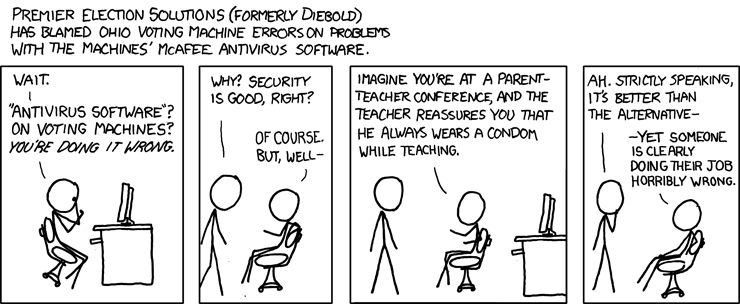
"... yet someone is clearly doing their job horribly wrong."
A little quiet here on the blog as I am currently head-down in my LLM dissertation, on the topic of the IP issues arising from the development of low-cost rapid prototyping machines such as the RepRap. But to follow up my last post I am pleased to say that the latest issue of SCRIPTed is now available, again featuring papers on topics as diverse as social pressures on medical ethics in Korea to the privacy issues arising from state access to the location data produced by devices such as mobile phones.

In the mean time, if you haven't come across the webcomic xkcd then I'd recommend checking it out. Usually very humorous for those of a slightly geeky disposition, it quite often excels itself in commenting on our information society, such as this splendid Map of Web 2.0. Today is no exception, as xkcd beautifully illustrates Bruce Schneier's aphorism that security is not a product, it's a state of mind:
Monday, 11 August 2008
A Couple of Plugs
No, not the plugs in Amp v Utilux (I had to sneak a design law case reference in here somewhere!) Rather, I'd like to draw readers' attention both to SCRIPTed and to the forthcoming SCRIPTed Conference in Edinburgh.
SCRIPTed describes itself as 'a journal of Law, Technology and Society'. Having been privileged to serve as one of its editors over the last year, I think it fair to say that it covers these bases very well. The most recent issue (Vol 5 No 1) includes papers on trade mark dilution, user attitudes to P2P services and the ethical issues surrounding 'bionic' athletes. We are interested in prospective contributions for SCRIPTed, and we are also keen to hear from suitably-qualified referees to help peer-review submissions.
Not content with running a journal, our managing committee are organising the SCRIPTed Conference, to take place at the University of Edinburgh from 29-31 March 2009. Taking as its theme 'the Governance of New Technologies', it will focus on evolving and emerging technologies and new-technology-driven practices and their impact on the overlapping fields of healthcare, information technology and intellectual property. The Call for Papers is open until 15 November, whilst an outline programme is available. So, why not make a date in your diaries for what promises to be a fascinating and enjoyable three days in the beautiful city of Edinburgh?
Wednesday, 6 August 2008
Computer Says Yes, Mr Bin Laden - have a nice trip!
To err is human, goes the saying, but to really make a mess of things requires a computer. Yet everyday experience suggests that we tend to be remarkably trusting of the output of computers - perhaps the most common recent example being the stories of drivers cheerfully following GPS directions the wrong way up one-way streets, or even through floods or onto railway tracks.
All of which makes this story in The Times about cloning of electronic passports all the more worrying. E-passports have been held up as the gold standard of travel security (despite the loudly-voiced concerns of security experts) and there is a risk that airport check-in or security staff, faced with a suspect traveller, will see an e-passport as an unquestionable confirmation of identity. We may laugh at the stereotype of someone who abdicates all responsibility to a computer, but should we be more worried when the response is not "computer says no" but "computer says yes"?
Tuesday, 5 August 2008
A Lost Voice of Reason
I'm very saddened to see that William Patry has decided to close his long-running and very highly regarded copyright blog. Even more depressing are the two main reasons he gives for doing so: that the copyright system has become so overwhelmed by the interests of massive corporate rightsholders as to in his view leave it beyond hope of repair; and that it had become impossible for him to present his own views without them being assumed to be those of Google, his current employer.
More and more, any discussion of copyright seems polarised between ever more extremist positions, with those on one side demanding ever wider and more prolonged protection for anything that can be shoehorned within the confines of 'intellectual property' and those on the other for whom "information wants to be free" has become a mantra to be recited in the face of any suggestion that artists should be able to benefit from their creativity. More than once I have had to explain that just because I am an aspiring IP lawyer it does not mean that I favour unlimited expansion of copyright any more than someone wanting to practise land law would necessarily want to abolish rights of way and enact a right to shoot trespassers on sight. We need IP centrists like Patry to point out that there is a sensible middle ground - even if we seem to be ever more losing sight of it.
I see that many of the people commenting on Patry's final post have implored him to at least make the archives available in some form (he has currently removed them because of what he sees as the ongoing problem of having his opinions cited as those of Google). I've added my voice to this plea; this is too deep a well of good sense to be filled in forever.
Subscribe to:
Posts (Atom)


 Posts
Posts

